

Where to Direct Gaze in Locust Pose Optimal Alignment
Why the cervical spine wants you to direct the gaze downward in Locust Pose.
Have you considered the position of the neck in different yoga postures? In this article I explore where to direct your gaze in locus pose for the best alignment
As yoga teachers, we have an opportunity to improve our teaching by exploring the intricate relationship between anatomy and alignment. In this article, we will delve into the often-neglected aspect of Locust Pose (Shalabhasana)—the gaze and its impact on the neck. By understanding the significance of maintaining the natural curve of the cervical spine, the role of the suboccipital muscles, and the potential variations in gaze direction, we can guide our students to optimal alignment so that they get the most out of their practice.
Picture your students in Locust Pose—where are they looking? Up, forward, down? Not sure? Where should they be looking? Well, that depends. Let's first look at the anatomy!
The Significance of the Cervical Lordosis:
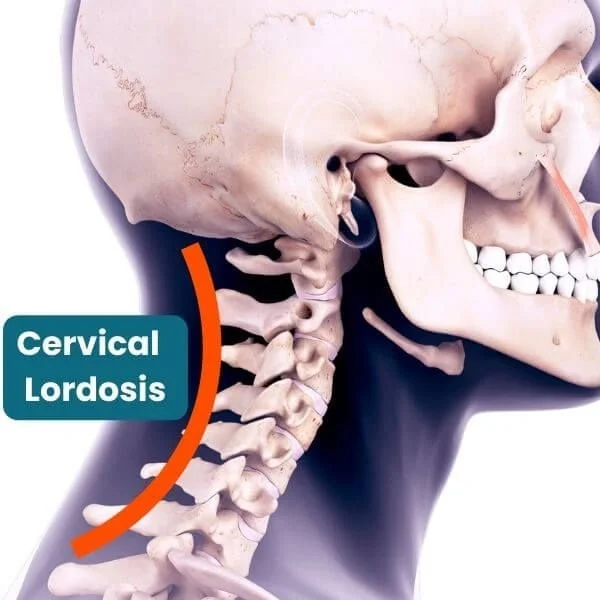
The cervical spine, consists of seven vertebrae and possesses a natural curve known as lordosis. This is a subtle inward curvature resembling the letter "C." This curve, when maintained, promotes optimal alignment of the neck. It allows for the weight of the head to be best supported. Being able to access the natural lordosis of the cervical spine also helps with improved strength and mobility of the neck. And this is really important! We need to be able to look around. No one wants to have to stop driving because they can't turn their neck. And no one wants to struggle to look up at the world and people in front of them!
Where Do You Direct the Gaze in Locust Pose?
Now, let's dive into the topic of gaze in Locust Pose. Some teachers tell students to look up. Others say to look down. And of course some teachers don't pay much attention either way! Do you have a preference? If so, why? What do you typically do in your own practice?
I am a firm believer that the human body is safe to move in just about any way - as long at the tissues are prepared for it. In other words, you can look up, forward, down, or even off to the side. What I'm most interested in though, is finding the positions of optimal alignment first! Optimal postural alignment creates stability and muscular efficiency. Once those are established, mobility becomes easier to access.
So which direction should the gaze be in for optimal alignment of the neck in locust pose?
Well, before we make that decision, lets look at the typical anatomical alignment of people's spine in modern day society! People spend a lot of time sitting and leaning their head forward towards a computer screen or down towards a phone. This often contributes to forward head posture. When the head juts forward, misaligned with the shoulders, it disrupts the natural curvature of the cervical spine. The weight of the head places increased stress on the neck and upper back muscles. Over time, this can lead to a loss of cervical lordosis (the natural inward curve) and an increased thoracic kyphosis (excessive rounding of the upper back). This postural imbalance can cause discomfort, pain, and restricted mobility.
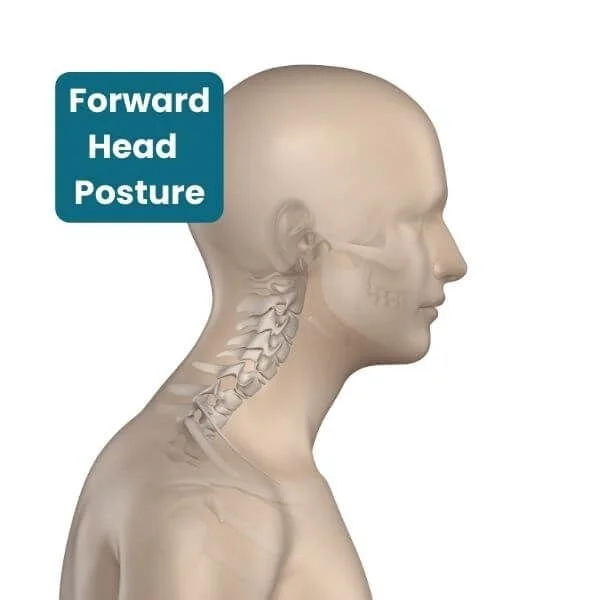
The cervical spine can easily flex (as it does when you bow your head down towards your chest). Once the weight of the head is forward of the body, the cervical spine naturally wants to flex and this is what happens with the forward head posture. But here's the thing, you can't see if you are looking down. So people compensate. Even though they have forward head, they don't just go into neck flexion -- they tend to flex the majority of the neck and then extend the very top part of the neck (C1-C2 and C2-C3). They do this by using the suboccipitals. These are small muscles designed to stabilize the head on the neck and to create small corrective movements of the head. But when they are used to lift the weight of the head, they are overstrained! This is one of the common causes of headaches. Those little muscles are not set up to lift the head all day, so they get a little angry!
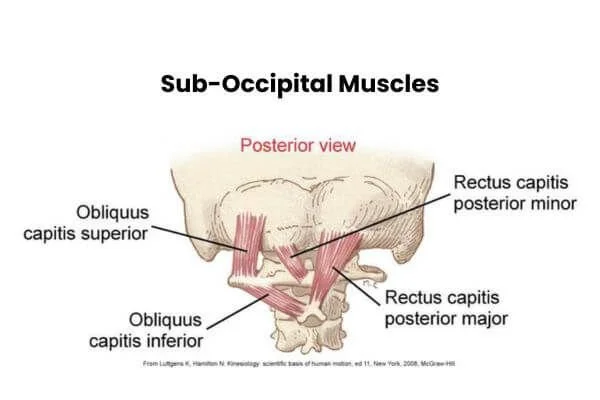
What do the subocciptial muscles and forward head have to do with the direction of the gaze in locust pose?
The Strain of Looking Up:
Here's a question to ponder: What happens when your students look up in Locust Pose? By turning their gaze upwards, many students unintentionally place strain on the suboccipital muscles—those small yet significant muscles at the base of the skull. They do this by moving at just the upper cervical spine. Looking up brings the eyes up and may give the practitioner the sense of lifting higher. That could be beneficial, but the strain on the suboccipital muscles disrupts the alignment of the cervical spine. It may contribute to the forward head posture discussed above. It also may feel natural for those who present with forward head posture -- they are just used to over-activating those little suboccipital muscles.
The Benefits of Looking Down:
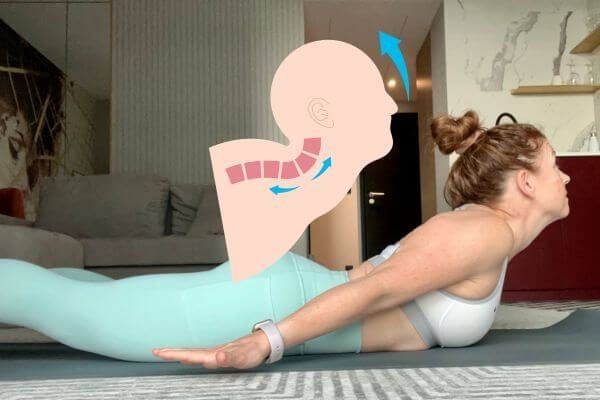
By directing the gaze downward, we actively support the preservation of the cervical lordosis. This alignment encourages the presence of the natural curve of the neck. By encouraging a downward gaze in Locust Pose, we promote an active lengthening of the suboccipital muscles rather than straining to concentrically contract them. For many students, a downward gaze also enhances their focus and internal awareness, facilitating a deeper connection with their breath and body during the pose.
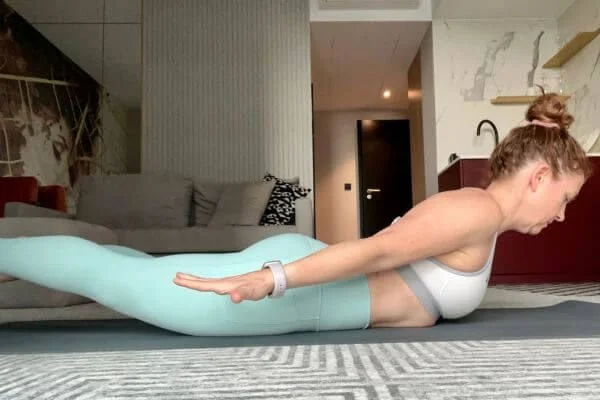
.The alignment of the neck created by looking down, encourages the presence of the natural cervical lordosis. As yoga teachers, we aim to guide our students towards a balanced and harmonious practice. By encouraging a downward gaze in Locust Pose, we actively promote the lengthening of the suboccipital muscles rather than straining to concentrically contract them. For many students, a downward gaze also enhances their focus and internal awareness, facilitating a deeper connection with their breath and body during the pose.
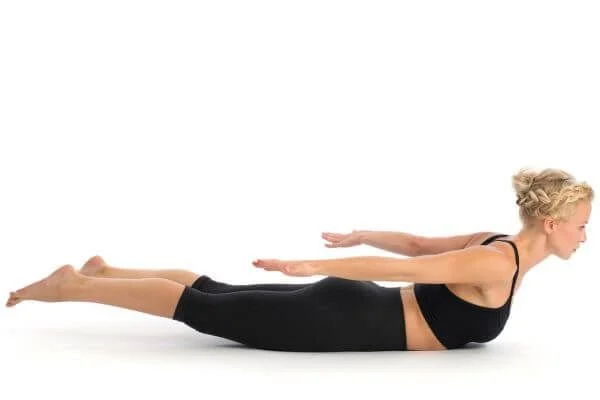
Of course the direction of the gaze will be impacted by the level of mobility throughout the whole spine. For a student that lifts up high, they will have increased extension of the lumbar and thoracic spine which causes the cervical spine to be lifted higher. In such cases, the practitioner may be able to look forward while maintaining cervical lordosis.
Exploring Variations of Locust Posture:
While my general recommendation is to direct the gaze downward, there can be individual variations. The curves of the spine reverse with movement and we don't need to be afraid to let that happen. We can, however, encourage alignment that not only creates efficiency in the pose, but also improved health of the spine.
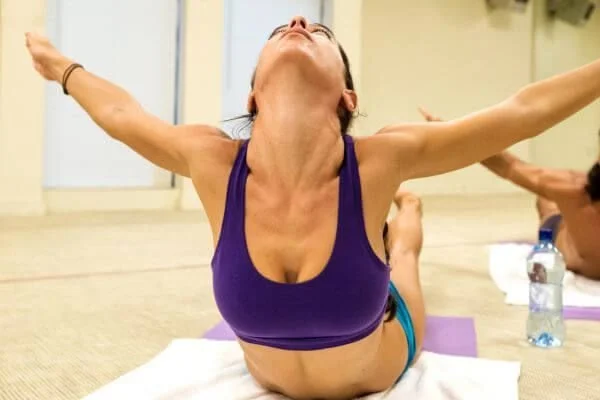
Let's explore the possibility of looking up in Locust Pose while seeking optimal alignment. My best advice is to emphasize the importance of moving the entire spine in the movement rather than relying solely on the movement at the upper most cervical vertebrae. By consciously involving the entire spine, students can distribute the physical efforts more evenly, minimizing excessive tension in the suboccipital muscles. This approach allows for a balanced extension of the spine. When the whole spine is actively extending, the cervical spine can be better supported moving into extension. Yes, this will reverse the cervical lordosis, but we need to be able to do that. If a practitioner truly activates their entire spine, the subocciptials will not be overstrained as other other larger neck muscles will be active.
As yoga teachers, we have the privilege and responsibility of deepening our understanding of anatomy and alignment. In Locust Pose, the alignment of the cervical spine plays a pivotal role. By honoring the natural curve, directing the gaze downward, and exploring variations with awareness, we empower our students to embark on a transformative journey towards optimal alignment. So, the next time you guide your students through Locust Pose, invite them to explore the position of their necks and experience what they feel. This is one way to encourage them to embrace the wisdom of their bodies, and discover the connection between alignment what is possible in their yoga practice.
Ready to teach yoga with confidence?
Discover Power to Lead 200-Hour Yoga Teacher Training in Lisbon, Portugal. Led by Dr. Trish Corley - the only yoga teacher training in Portugal taught by a Doctor of Physical Therapy.
[Learn more about the 200 hour yoga teacher training in Lisbon]
About the Author
Dr. Trish Corley, PT, DPT (physiotherapist), E-RYT 500, is the founder of Yoga Anatomy School and a former anatomy professor with over 23 years of clinical experience. She has been teaching and mentoring yoga teachers in anatomy and biomechanics since 2012.
Explore the Yoga Anatomy Online Course at TrishCorley.com/yoga-anatomy-course.
For more articles and insights, visit TrishCorley.com.