

Do Twists in Yoga Detoxify? What About Sidebends?
It's a common yoga myth that twists in yoga detoxify the organs and other aspects of the body. What is happening in the spine in twists and sidebends?
A quick search on the internet on "how twists in yoga detoxify the body" will leave you with over 1.6 million listings explaining the various benefits of twists and how to do them safely. My gut instinct says that twisting and bending the body in various ways is beneficial to the body. All parts of our bodies need movement to heal and stay healthy. To what extent is there detoxifcation happening with spinal twists? This takes a deep understanding of human physiology at a very complex and cellular level. While some research has been performed, there is not enough out there to support the blanket statement that 'twists detox the body.'
What we do know is that the spine is made to move and movement is therapeutic.
In this article, you can learn more about spinal movements and how to incorporate a balance of forward bends, backbends, twists and sidebends to create a holistic and healing yoga sequence.
Understand how the spine moves and gain confidence as a yoga teacher.
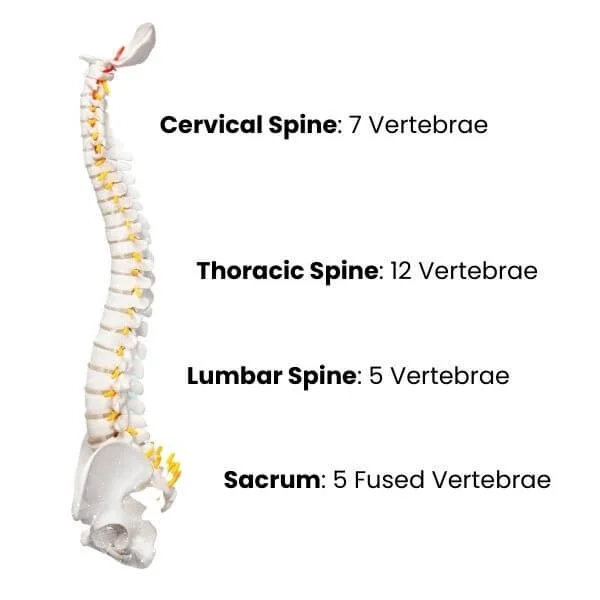
Regions of the Spine and the Number of Vertebrae
Here is a quick review from another article on the spine that focused on forward bends and backbends. Do you remember the different parts of the spine?
The Cervical Spine (the neck) has 7 vertebrae.
The Thoracic Spine (area of ribs) has 12 vertebrae.
The Lumbar Spine (low back) has 5 vertebrae.
The Sacrum has 5 vertebrae that are fused together.
There are three planes that the spine can move in. In each plane, it can move in 2 directions. That means the spine moves in 6 different directions all togther. These directions include (1) flexion, (2) extension, (3) sidebending to the left, (4) sidebending to the right, (5) twisting to the left, and (6) twisting right.
If you want to review The Functional Anatomy of Forward Bends and Backbends, Click HERE.
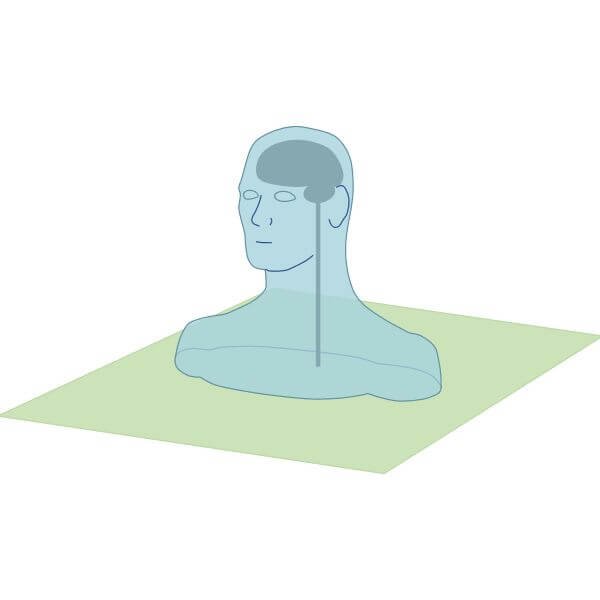
Horizontal Plane Divides Top & Bottom
Take a Look At Spinal Twists
Spinal twists in anatomical terminology are called spinal rotation. While forward bends and backward bends occur on the sagittal plane, twists (or spinal rotation to the left and right) occur on the Horizontal Plane. The horizontal planes divides the body into the top and the bottom. When one part of the body moves in relation to the other on the horizontal plane, the result is rotation. This is what occurs in your neck when you turn your head from side to side to say "no". It is also the movement that occurs in your thoracic and lumbar spine with yoga postures such as supine twist and twisted lunge.
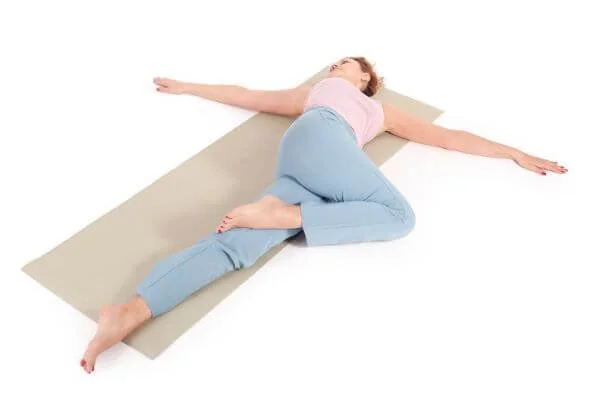
Supine Twist - A Yoga Posture with Spinal Rotation
In this supine twist, the person's cervical spine is rotated to the right, hence they are looking over their right shoulder. Their lumbar (lower spine) is rotated in the opposite direction (to the left).
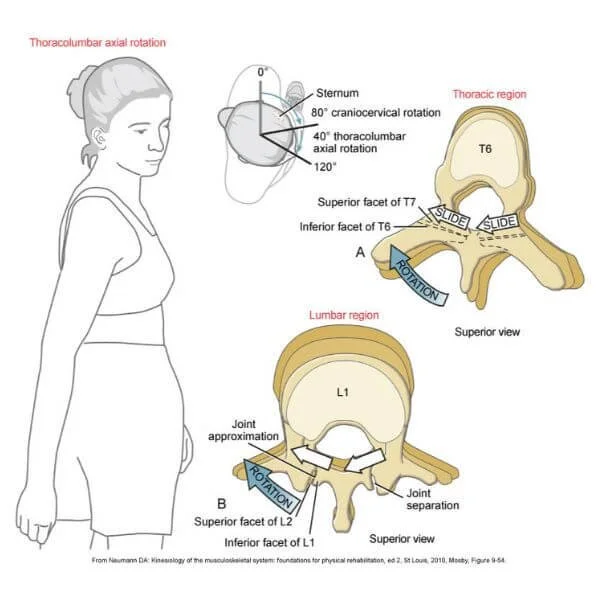
Spinal Rotation at the Level of Each Vertebrae
When the spine is rotated, one vertebrae rotates in relation to the other. With a total of 24 moving vertebrae, the spine is set up for a lot of rotation. The cervical spine usually has the most amount of rotation available compared to other parts of the spine. The lumbar spine usually has the least amount of rotation available. The thoracic spine typically has a lot more rotation available to it compared to the lumbar spine. This is important to note! It is common for people to aim to primarily twist the lumbar spine/low back in twisting postures..
If there is more rotation available at the thoracic spine, we are better off to encourage twisting at the rib area, not the low back!
You might be thinking, 'hey, I thought this article what about detoxing with twists. Well it is and it is not. At the Yoga Anatomy School, we believe that alignment of our body, mind, and soul is essential to being free of injury and disease. My goal is for you to understand enough functional anatomy (and effective ways to share it) so that you can create a yoga practice/sequence that is holistic and brings alignment to the body. So let's get back to the movements of the spine. .
What is sidbending?
Sidbending to the left and to the right occur in the Frontal Plane. The frontal plane divides the body in the front and back. If you drop one ear to your shoulder and then the other in a "tik tok" motion of your head, you experience sidebending of the cervical spine in the frontal plane.
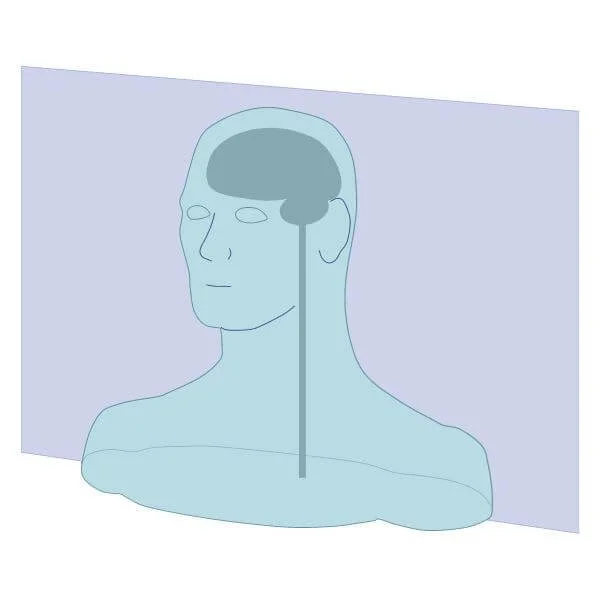
Frontal Planes Divides the Body in Front and Back
It seems there are not a lot of common yoga postures where the spine tends to be in sidebending. One of the more common is seated sidebend and it's variations. I also like to do the sidebend in a lunge as is seen on the cover photo of this article. Can you think of any others?

Recently, we looked at how people do poses differently. I encouraged you to avoid the assumption that a particular pose always puts the spine in a particular position. For example, some people do child's pose with spinal flexion, while others do the pose with spinal extension.
What position is the spine in triangle pose? Is it sidebending? You may have guessed my answer. As my answer commonly is "it depends!" I like to play with keeping my spine neutral with no sidebending when I practice triangle. But sometimes I sidebend.
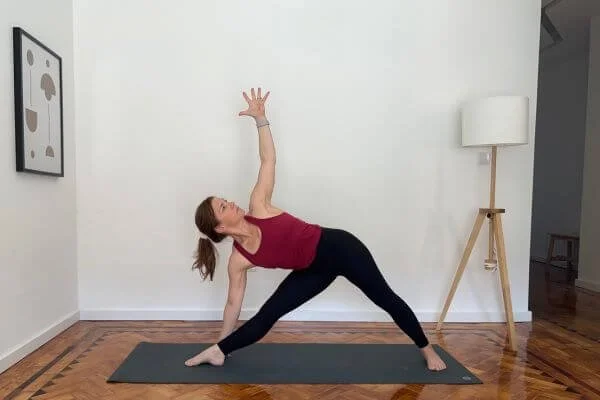
Triangle Aiming for Neutral Spine Position/ No Sidebending
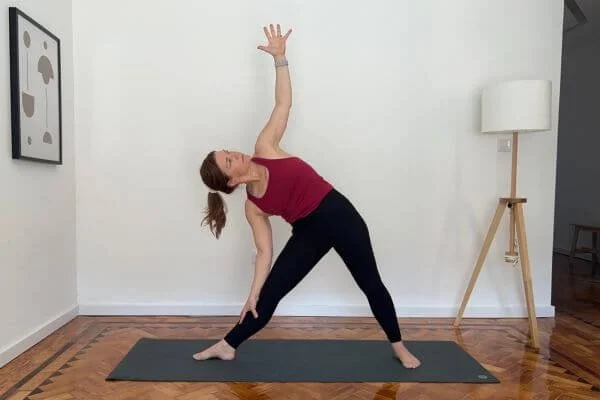
Triangle with a Right Sidebend.
Sometimes I like to explore what my spine can do in triangle. If I am feeling up to it, I might add spinal rotation or even a backbend.
Take a look at the photos below to see the different positions of my spine in triangles.
In the next photo, I rotated my spine past neutral. You can see my right shoulder and ribs are moving up towards the ceiling. My left shoulder and ribs are moving down towards the mat. This is the result of twisting the spine.
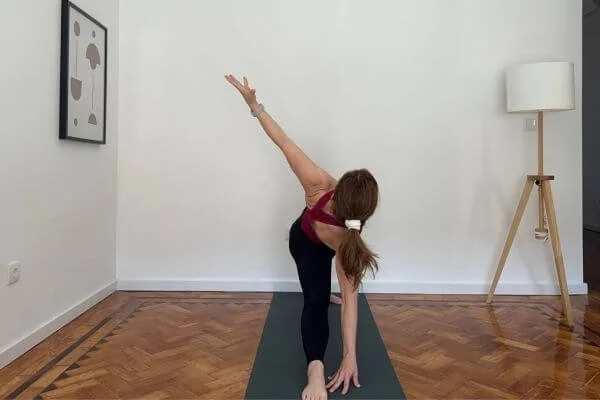
Triangle with Intentional Spinal Rotation
After prepping and leading a practice on backbends and forward bends, my spine was feeling rather mobile and strong. I played with the version of triangle with a backbend. The possibilities are endless when you understand the anatomy!
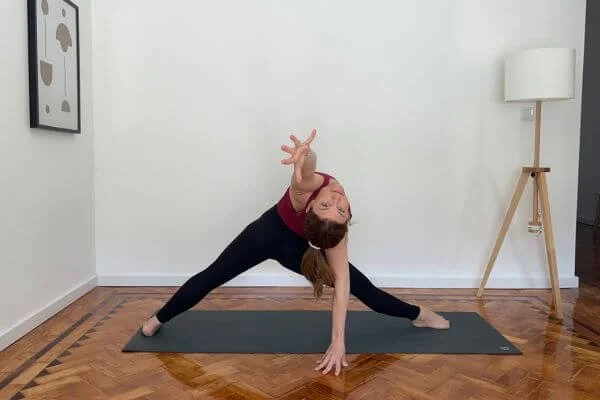
Triangle with a Backbend or Spinal Extension
Remember that understanding the movements of the spine takes some practice...just like all aspects of yoga. So practice! Get into your favorite yoga poses. Is you spine in flexion or extension (or neither)? Is is rotating? Which way? Where is most of the rotation coming from? What about sidebends? Do you even have sidebends in your practice?
** Getting good at understanding yoga anatomy will take practice and looking at different bodies. So look at your students. Avoid assuming you know what the are doing!**
There is so much to learning the anatomy of the spine! At Yoga Anatomy School you get small digestible doses of anatomy. We go deep into the exploration of human posture and a balanced yoga practice with the theory of Optimal Postural Alignment.
If you are reading this blog, you are ready to learn. Inside the Yoga Anatomy School, you can learn so much more. We offer interactive live and recorded videos, a workbook, mentorship, and a community to support you! I am so excited to invite you to experience a sample of what happens inside the Yoga Anatomy School with live (and recorded) courses and yoga teacher trainings.
Ready to teach yoga with confidence?
Discover Power to Lead 200-Hour Yoga Teacher Training in Lisbon, Portugal. Led by Dr. Trish Corley - the only yoga teacher training in Portugal taught by a Doctor of Physical Therapy.
[Learn more about the 200 hour yoga teacher training in Lisbon]
About the Author
Dr. Trish Corley, PT, DPT (physiotherapist), E-RYT 500, is the founder of Yoga Anatomy School and a former anatomy professor with over 23 years of clinical experience. She has been teaching and mentoring yoga teachers in anatomy and biomechanics since 2012.
Explore the Yoga Anatomy Online Course at TrishCorley.com/yoga-anatomy-course.
For more articles and insights, visit TrishCorley.com