

Three Tips to Master the Alignment of Warrior One
Keep the alignment of warrior one pose simple!
The alignment of Warrior One Pose doesn't need to be so complicated!
Warrior one posture is one of the more commonly practiced postures. Amongst yoga teachers and practitioners, there can also be a lot of controversy regarding the "right" alignment.
Hear me out! There is no "right" or "wrong" alignment in any pose.
There are, however, alignment principles that can be applied to any yoga posture that can be used to create efficiency and balance. Taking action towards more efficient alignment creates more ease in the postures. There is a delicate balance of effort to align complemented by ease in the alignment. This balance allows students to experience peace while also building strength and flexibility.
Here are three essential alignment tips to help your students find ease in Warrior One while also building strength and mobility
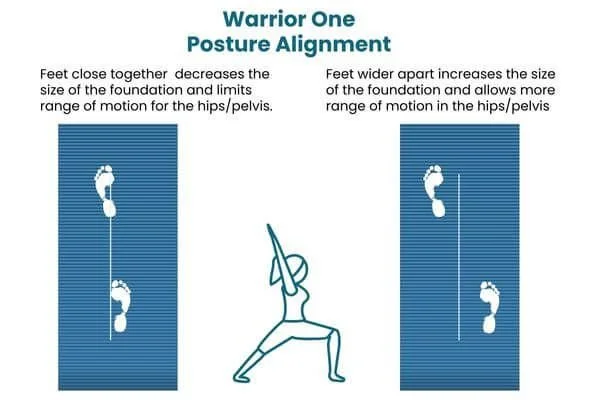
1. A Broad Foundation: Keep the Feet at Least Hip Width's Apart.
It's common for student's to keep their feet rather close together. This can look like a short stance from the front to back of the mat. It can also look like a short stance from left to right (or laterally). When the feet are close together in the lateral position, it makes it difficult for the pelvis to move freely. The pelvis moves on the femur bones. When the feet are close together, so are the femur bones. This essentially leaves very little room for the pelvis to move.
In order to create space for he pelvis to move, bring the feet at least hip width apart. It seems a lot of people respond well to the analogy of feet on railroad tracks instead of one line.
2. Bring Your Knee Over Your Ankle
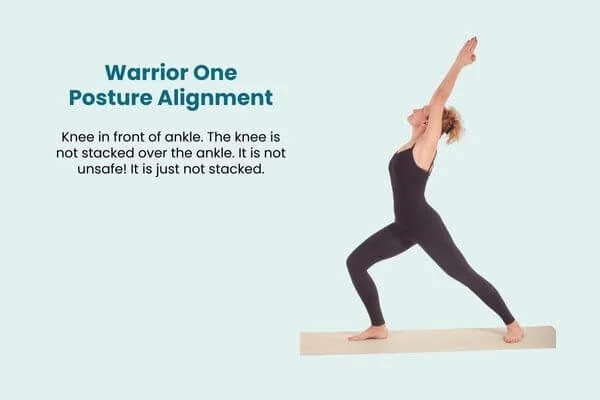
I said it! Bring your knee over your ankle. You may have heard or even teach this cue; and you may think it "protects the knee." What if it has nothing to to with protecting your knee? Please don't get caught in the trap of using alignment cues as if you are the "safety police.!
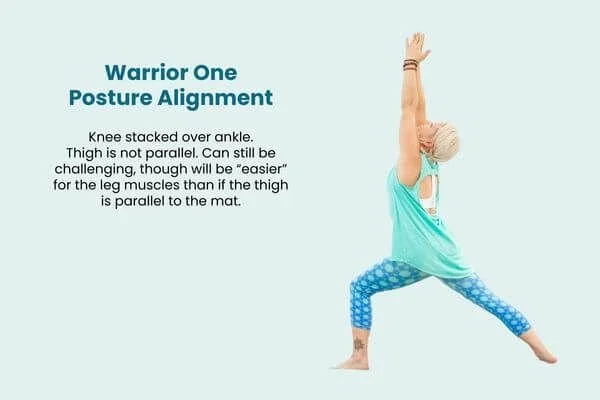
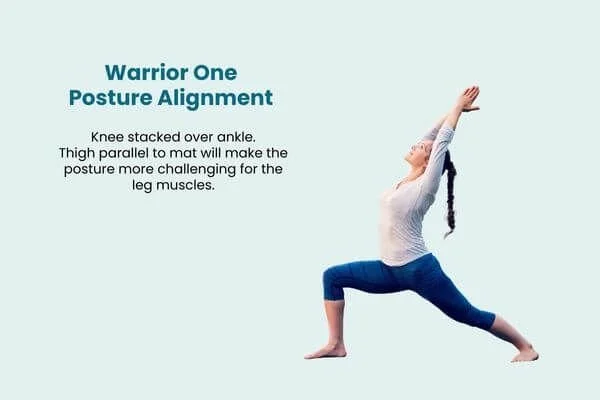
When it comes to warrior one, getting your knee over your ankle isn't about babying your knee. It's actually about setting up your body efficiency! When the knee is directly aligned over the ankle, the shin bone is stacked over the ankle bones. This alignment helps distribute weight evenly, creating more stability. If the bones are well stacked, the muscles need not work so much. By stacking the bones, you're telling your muscles, "Hey, let's work together and make this pose a little easier." In other words, do the work to stack the knee over the ankle in order to make the pose easier!
And please note this! Stacking the knee over the ankle is different than bringing the thigh parallel to the ground! If you want to challenge the quadricep muscles more, by all means, aim to bring the thigh parallel to the ground. This is certainly a possibility in warrior one. It's not right or wrong; perhaps just more challenging. This also means that you can make the posture easier by bringing the thigh bone away from parallel.
3. Aim for a Neutral Pelvis - Don't Force It!
Neutral pelvis is neutral. It's not tilted forward or backward. And in the alignment of warrior one posture, both hip points face forward. This, however, can get tricky! Many yoga teachers cue "Square the hips to the front of the mat or room." While this is the general direction of the pose, many students lack the range of motion in the hips to get there. Since the feet are fixed to the ground, the compensation will usually arise in joints above or below the hips. That means there may be some compromise in the knees or low back.
There are benefits of working towards "squared hips" including increased range of motion and strength. It's not wrong to work towards this alignment; it's just not good to force it! When I am teaching this pose with the right foot forward, I might say, "Press the front of your left hip towards the front of the room." This invites students to move towards the neutral pelvis without forcing anything.
Ready to teach yoga with confidence?
Discover Power to Lead 200-Hour Yoga Teacher Training in Lisbon, Portugal. Led by Dr. Trish Corley - the only yoga teacher training in Portugal taught by a Doctor of Physical Therapy.
[Learn more about the 200 hour yoga teacher training in Lisbon]
About the Author
Dr. Trish Corley, PT, DPT (physiotherapist), E-RYT 500, is the founder of Yoga Anatomy School and a former anatomy professor with over 23 years of clinical experience. She has been teaching and mentoring yoga teachers in anatomy and biomechanics since 2012.
Explore the Yoga Anatomy Online Course at TrishCorley.com/yoga-anatomy-course.
For more articles and insights, visit TrishCorley.com.